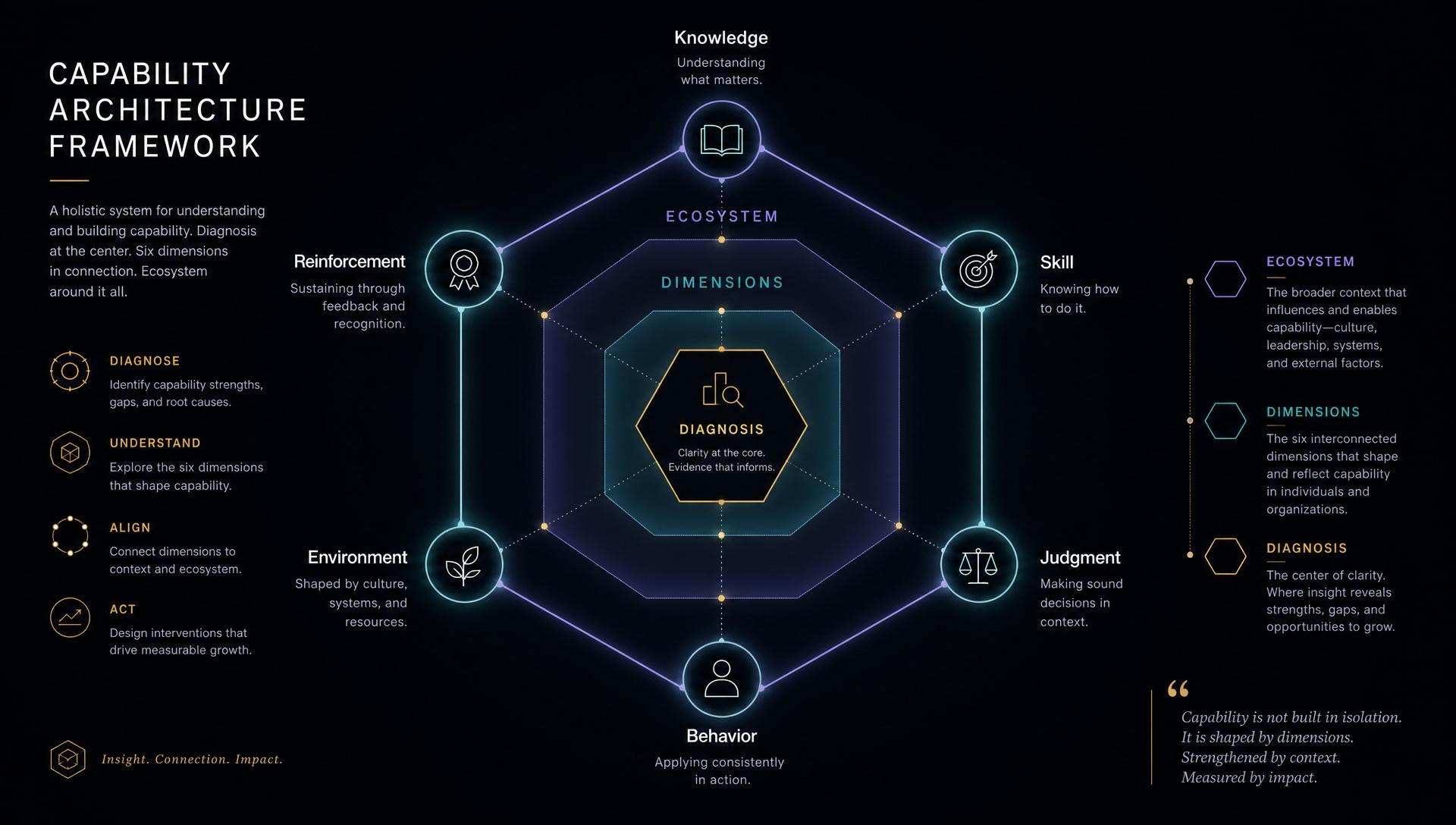
Capability Architecture.
What if capability isn’t something you train — but something you architect?
Organizations invest heavily in learning, yet people still struggle when it matters most. Capability isn’t created through information alone — it emerges through confidence, judgment, practice, reinforcement, coaching, and the environment surrounding the learner.
Diagnosis at the center. Six dimensions around it. Ecosystem holding it together.

The gap most programs miss.
Four lenses on the same question — why people complete training and still can't quite perform.
We measure activity, not capability.
Organizations measure completions, attendance, certifications, quiz scores. Yet these rarely answer the one question that matters:
"Can this person confidently perform?"

Six dimensions that make capability real.
Capability isn't a single skill. It's a layered system — and each layer is measurable, designable, and improvable.
Understanding concepts, information, and how the work fits together.
Baseline understanding steadies every other dimension.
Recall, application, and scenario reasoning.
Sharper product fluency and faster ramp time.

What's actually preventing success?
The intervention should follow the root cause — not the assessment score. Pick what's getting in the way; watch the recommended support change.
I don't know.
Avoid a full course when a short explanation will do.

The layers, end to end.
Click any layer to open its purpose. Each one earns its weight in the next.