02AI Lab · Applied AI adoption architecture

Applied systems for human-centered AI adoption.

An operating environment for AI-enabled enablement — frameworks, scorecards, dashboards, and adaptive practice infrastructure built to live inside real workflows, not adjacent to them. The work: reduce friction, protect human judgment, build capability, and make AI usable, governable, and scalable inside organizations.

02.1AI Adoption Operating Model · Flywheel

A continuous operating rhythm — not a one-time rollout.

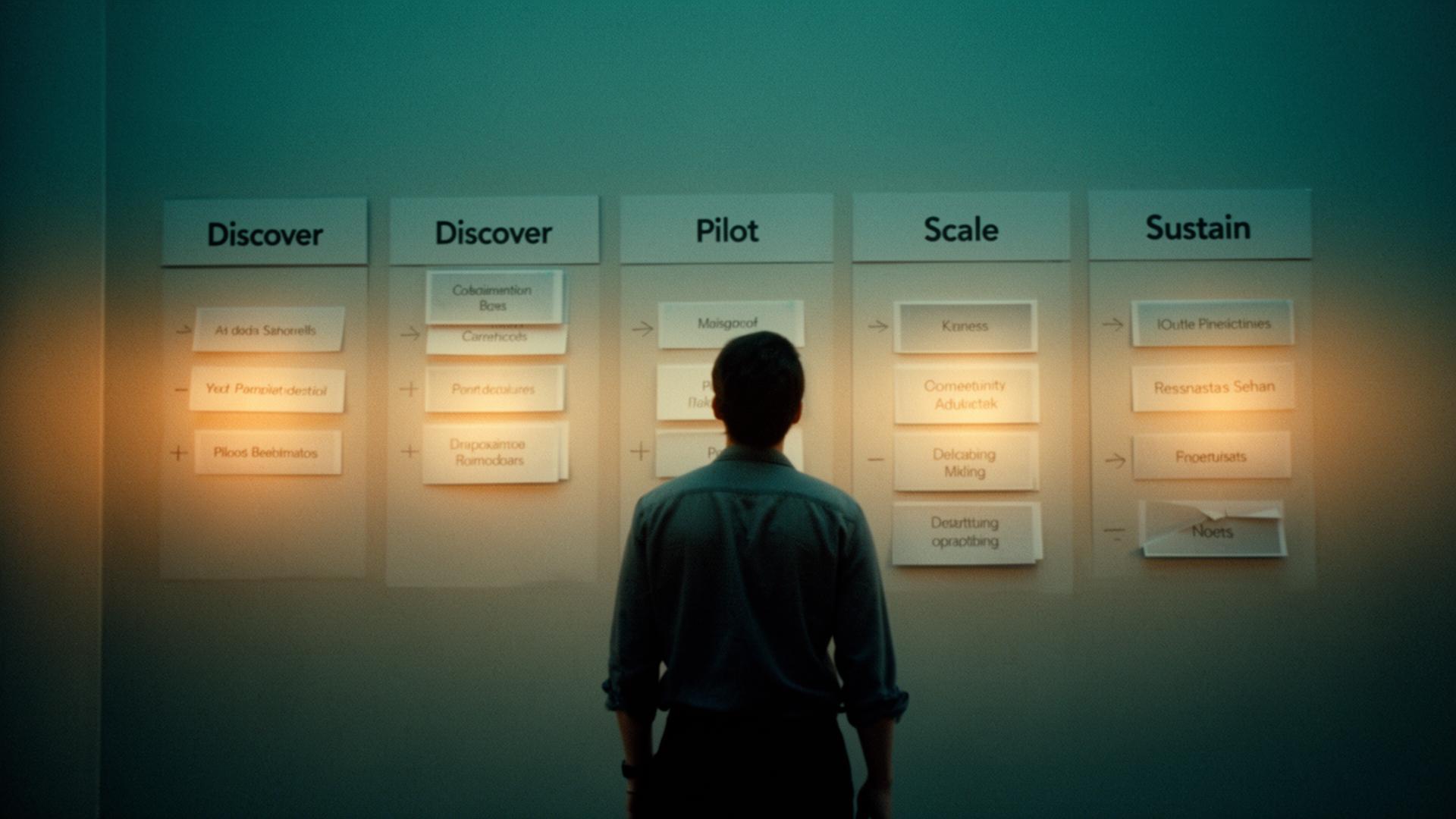
AI adoption is not a one-time rollout. It is a continuous operating rhythm: discover high-value workflows, assess readiness, prioritize use cases, design the human + AI workflow, pilot safely, measure behavior and business outcomes, then govern and scale what works.

  1. Step 01
    Discover

    Find high-value workflows.

    Identify where work is slow, inconsistent, repetitive, risky, or knowledge-heavy. Look for expert bottlenecks, manual synthesis, repeated handoffs, slow decision cycles, and workflows with unclear ownership.

    Output
    Workflow inventory and opportunity backlog.
Loop→ back to Discover. Adoption is a rhythm, not a finish line.

AI adoption · continuous operating rhythm

02.2AI Readiness Scorecard · Matrix

A readiness matrix, not a linear process.

Score each workflow against value and readiness, then place it on the matrix to decide whether to pilot now, prepare first, take a quick win, or pause. A representative set of readiness dimensions is shown below.

Business value →
High value · Low readiness
Prepare first

Worth the effort, but readiness work has to come before a pilot.

High value · High readiness
Pilot now

Strong candidate. Move into design, pilot, and measurement.

Low value · Low readiness
Pause

Not the work to lean into right now.

Low value · High readiness
Quick win — or deprioritize

Easy to do, but don't let it crowd out higher-value work.

Readiness →
Representative readiness dimensions
  • Workflow Clarity1–5
  • Business Value1–5
  • Data Sensitivity1–5
  • Stakeholder Readiness1–5
  • Governance Needs1–5
  • Measurement1–5

Full scoring rubric available in working sessions.

Interpretation
40–50
Strong pilot candidate
30–39
Promising — needs readiness work
20–29
Discovery needed before pilot
< 20
Pause or redesign the workflow first

Recommendation format: Pilot / Prepare / Pause · why · primary risk · success metric · next step.

Dashboard Concepts · Visual prototypes

Four measurement surfaces for AI adoption.

Concept tiles — visual representations of the dashboards that sit on top of the operating model. Not interactive products in this pass; framed as measurement surfaces for adoption, not vanity metrics.

Dashboard concept
AI Use Case Portfolio

A portfolio board, not a wish list. Move opportunities through discovery, prioritization, pilot, scale, and sustainment as they earn the next column.

What it proves

AI adoption can be operationalized as a managed portfolio, not a random collection of experiments.

Dashboard concept
AI Adoption Health

Whether AI-enabled workflows are actually being adopted — behavior change, not seat licenses.

What it proves

Behavior change and sustainment — not just enablement delivery.

Dashboard concept
Workflow Transformation Impact

An iteration loop on the workflow itself: baseline, redesign, pilot, measure, iterate — and only then declare what changed.

What it proves

AI adoption can be connected to measurable business outcomes.

Dashboard concept
Capability Architecture Map

A layered system view — outcomes sit on top, supports stack underneath. Each layer earns its weight in the next.

What it proves

Systems thinking — not one-off training assets.

02.4AI Practice + Evaluation Systems

The AI systems people actually practice with.

Sparring agents, prompt and persona systems, evaluation harnesses, guardrails, workflow intelligence patterns, and performance-support agents — the applied side of the operating model.

Applied in bootcamp system
Applied
AI-Supported Practice Infrastructure

Sparring agents and practice partners for sales, leadership, and onboarding — scored against a rubric so learners know exactly what to improve.

Practice loop
Learner responseAI challengeRubric signalFeedbackNext level
Applied
Evaluation + Guardrails

Rubrics, evaluation harnesses, and review checkpoints that score AI behavior against what matters — with SME review and drift checks so quality stays honest.

Evaluation chain
ConversationScoring criteriaFeedbackCoaching insight
Looking for concept work?

Cadence CareOS, AI Enablement Hub, and EPCOT-inspired experience concepts now live in the Concepts section — exploratory product, workflow, and experience systems separate from the applied work in the Lab.

Visit Concepts